Battery Rebate Changes from 1 May 2026: What Homeowners Need to Know
If you’ve been considering installing a home battery, the clock matters more than ever.
From 1 May 2026, important battery rebate changes will come into effect under the Australian Government’s Cheaper Home Batteries Program, and they will directly impact how much financial support households can receive.
Here’s what’s changing, why it’s happening, and what it means for Queensland homeowners.
A Bigger Program With Structural Adjustments
In December 2025, the Federal Government announced a significant expansion of the Cheaper Home Batteries Program — increasing total funding from an estimated $2.3 billion to $7.2 billion over the next four years.
The goal is ambitious: Support more than 2 million battery installations by 2030, adding around 40 gigawatt hours of storage capacity to Australia’s grid.
To ensure the program remains sustainable as uptake increases and battery prices continue to fall, the government has introduced structural adjustments to how the rebate works. These battery rebate changes will officially take effect on 1 May 2026.
What’s Changing From 1 May 2026?
The key adjustment relates to how the discount is calculated through Small-scale Technology Certificates (STCs).
The rebate is delivered via STCs, which are created based on a system’s usable battery capacity. To fund the discount, the government purchases the equivalent number of STCs generated.
From 1 May 2026:
1. The STC Factor Will Decline Faster
Previously, the STC factor was reduced annually. It will now reduce every six months, and at a higher rate.
This means rebate values will decrease more quickly over time.
2. Rebates Become Tiered by Battery Size
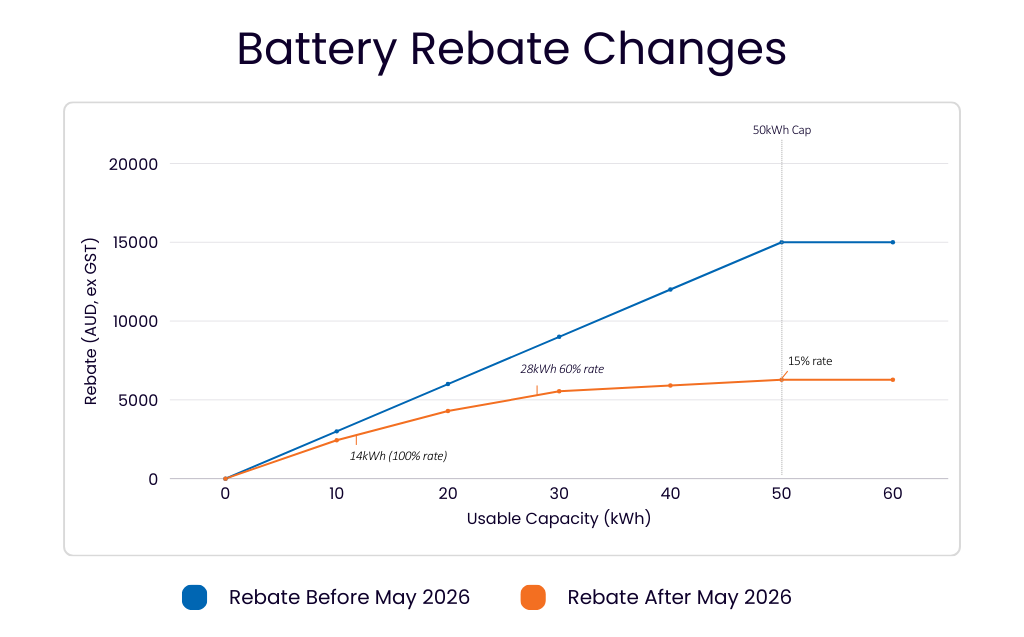
To prioritise standard residential systems, rebates will now scale based on usable capacity:
- 1–14kWh systems: 100% of the available rebate
- 14–28kWh systems: 60% of the available rebate
- 28–50kWh systems: 15% of the available rebate
The rebate still applies to systems between 5kWh and 100kWh, but only the first 50kWh of usable capacity is eligible.
For larger systems, this represents a substantial reduction compared to pre-May 2026 arrangements.
What Does This Mean for Queensland Homeowners?
For most average households installing a standard 10–14kWh battery, the government intends for the effective discount to remain around 30%.
However, the structure now clearly favours smaller systems and early installation.
What If Your Battery is Already Installed?
Nothing changes. The rebate is locked in at the time your system was installed and the STCs were created. The new battery rebate changes from 1 May 2026 do not apply retrospectively.
If your battery is installed before 1 May 2026
You secure the current, non-tiered rebate structure. This means:
- You receive the higher STC factor currently in place
- Your rebate is not subject to the new tiered reduction system
- You avoid the six-monthly STC decline structure
- You improve energy independence sooner
Installing before 1 May 2026 effectively locks in today’s stronger incentive settings.
If your battery is installed after 1 May 2026
Then, the new rules apply:
- Tiered rebates based on battery size
- Reduced eligibility for larger systems
- Faster six-monthly declines in STC value
These battery rebate changes are designed to stretch the program across its lifespan — but they also create a clear window of opportunity. Delaying installation could mean missing out on a bigger rebate.
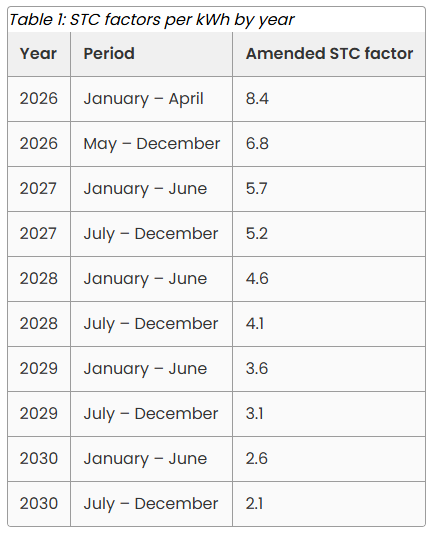
Table from Clean Energy Regulator.
Why Did The Government Make These Changes?
Battery costs are steadily declining as technology improves and production scales globally.
The updated structure aims to:
- Keep the discount at roughly 30% for standard home systems
- Align incentives with falling battery prices
- Ensure funding lasts through to 2030
- Support broad national uptake rather than heavily subsidising oversized systems
In short, the program is expanding, but becoming more targeted.
So, Should You Install Before May 1?
If a battery has been on your radar, the answer is a resounding yes. The timing is now part of the equation more than ever.
For Queensland households dealing with rising electricity prices and storm-related outages, battery storage remains one of the most effective ways to increase resilience and reduce reliance on the grid.
Ready to Secure the Current Rebate Before it Changes 1 May 2026?
The upcoming battery rebate changes don’t remove support, but they do change the timeline. If you’re considering adding battery storage to your solar system, now is the time to assess your options.
At DS Energy, we can help simplify the process and work out the best course of action for your needs. We can assess your home’s usage profile, solar production, and future energy needs before recommending the right battery size. We install premium, proven systems from brands such as Tesla, LG, BYD, Samsung and Sonnen, ensuring long-term performance and strong manufacturer warranties.
Most importantly, we provide clarity on your eligible rebate amount, the impact to you of installing before or after 1 May 2026, payback periods under both scenarios, and whether a battery genuinely makes financial sense for your home. You can check out the Solar Battery STC Calculator here.
If you’d like to better understand the broader picture, read our guide to residential batteries, and our home battery safety checklist, as well as our residential solar info page.
Speak to the DS Energy team today for a tailored review of your eligibility, system sizing, and savings potential, and secure the strongest available rebate before 1 May 2026.